


Zhangjiang Laboratory
The preparation of superconducting and quantum materials represents a key area of exploration in condensed matter physics, and the purity of the solvent directly determines the material’s properties and quantum behaviour. In the research and development of superconducting and quantum materials, the issue of solvent impurities has long posed a significant challenge: In traditional solvothermal and hydrothermal methods, metallic impurities in the solvent can affect the superconducting transition temperature of crystals and introduce lattice defects, leading to instability in the material’s quantum behaviour. Consequently, many studies on high-temperature superconductivity and quantum state control have struggled to progress due to solvent-related issues, creating a bottleneck that has hindered research breakthroughs.

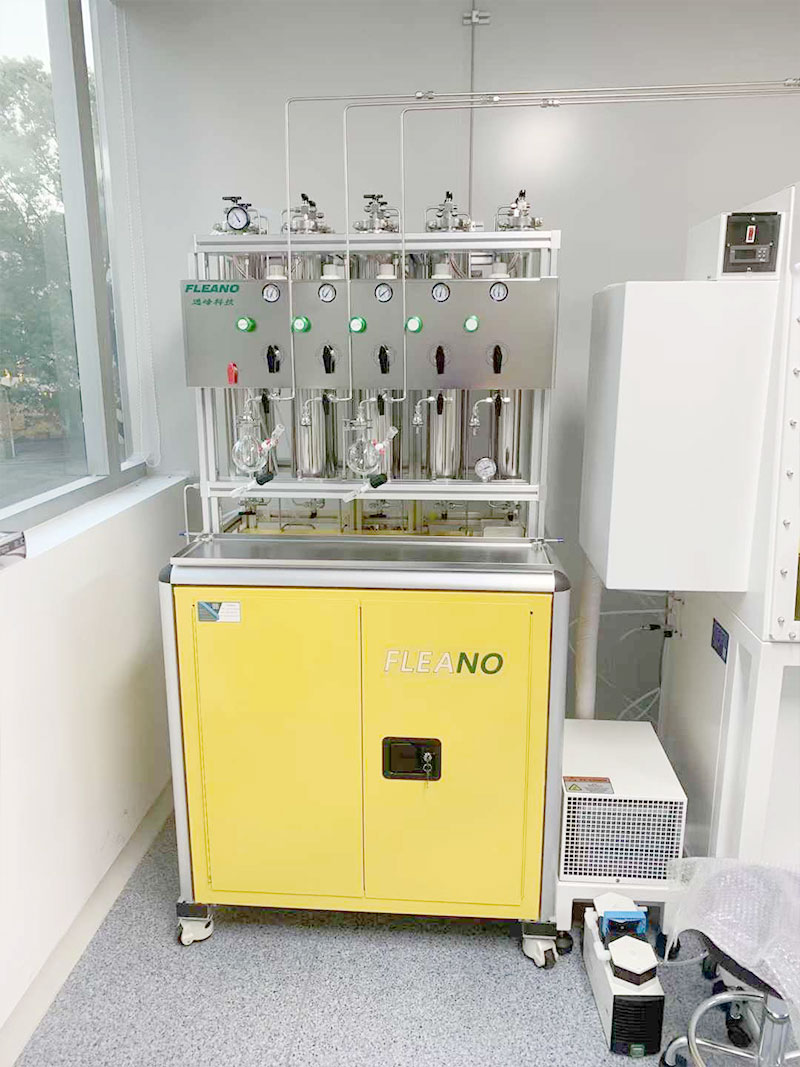
To overcome this challenge, the institute has introduced a solvent purification system from Beijing Yifeng Technology Co., Ltd. This system is designed for solvents commonly used in solvothermal and hydrothermal synthesis, such as ultrapure water and ethanol. It optimises the process for removing metal impurities, reducing their content to the ppb level and thoroughly eliminating impurities from the solvents, thereby ensuring the solvent purity meets the stringent requirements for the synthesis of superconducting and quantum materials. The system employs ultra-clean purification technology to prevent contamination, whilst also enabling automated liquid supply, which significantly enhances experimental efficiency and provides a stable foundation for material preparation.
The commissioning of the Yifeng Solvent Purification System has injected new momentum into the institute’s research and development of superconducting and quantum materials. The purified solvents have led to a substantial reduction in crystal defects within the materials, a significant increase in the superconducting transition temperature, and more stable quantum behaviour, thereby completely resolving material performance issues previously caused by metallic impurities. Researchers are now able to focus on optimising material structures and quantum states.
(The above content is for reference only and is not directly associated with any school or enterprise)